


Mom guilt is not a character flaw: here's what's going on
You worked today and felt guilty for not being home. You stayed home today and felt guilty for not contributing financially. You lost your patience for thirty seconds and spent the rest of the night replaying it like proof that you are failing. If mom guilt has been narrating your days, mama, I want you to hear this clearly. Mom guilt is not evidence that you are doing something wrong. It is evidence that you were handed an impossible, contradictory standard and told to meet it quietly.
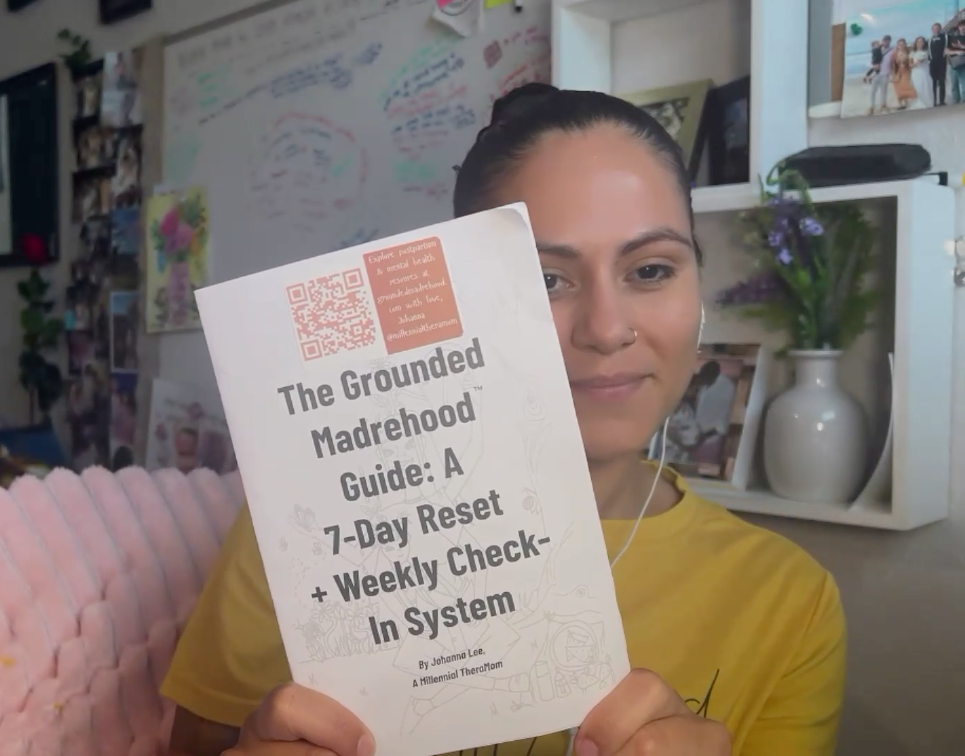
In case you are new here, I am Johanna Lee, a therapist for mamas navigating postpartum and motherhood, helping first generation, Latina, and mamas of color untangle their worth from an idea of perfection that was never realistic to begin with. Let's look at what is underneath the guilt you carry.
What mom guilt looks like day to day
Mom guilt rarely announces itself as one big dramatic moment. It shows up in the small, constant background noise, guilt for screen time, guilt for a shortcut dinner, guilt for wanting thirty minutes alone, guilt for enjoying work, guilt for not enjoying every second of motherhood the way you feel you are supposed to. It is a running internal commentary that you are never quite doing enough, being enough, or giving enough.
For many of the mujeres I work with, this guilt gets tangled with something deeper, an inherited belief that a good mother sacrifices everything and never complains. When that belief runs the show, guilt becomes the price you pay for having needs at all.
Mom guilt also has a sneaky way of attaching itself to decisions that have nothing to do with your actual parenting quality. You feel guilty for the type of birth you had, for how you feed your baby, for going back to work at six weeks or six months, for choosing daycare, for not choosing daycare. The decision itself rarely matters as much as the guilt insists it does. What matters is that guilt has found a foothold, and once it does, it tends to attach itself to whatever choice is in front of you next.
Some mamas describe guilt as a quiet undertone that colors an entire day, even a genuinely good one. You can have a wonderful afternoon with your kids and still end the day replaying the one moment you snapped, letting that single moment overwrite everything else that happened. This is not a fair accounting system, but it is how guilt tends to operate when it has been given too much authority over how you measure yourself.
The specific guilt of setting a boundary
One of the sharpest versions of mom guilt shows up the moment you try to protect your own time or energy. You say no to hosting the family gathering, or you ask your mother in law to text before dropping by, and the guilt arrives almost instantly, louder and faster than it does for almost anything else. That is not a coincidence. Boundaries interrupt a script many of us were raised on, where a good mother, a good daughter, a good mujer is endlessly available. If this particular flavor of guilt feels familiar, I go deeper into the mechanics of it in The step by step guide to setting boundaries as a new mom without guilt, because learning to tolerate that discomfort without abandoning the boundary is its own skill.
Where this guilt comes from
Guilt rarely arrives from a single source. It usually accumulates from several directions at once, cultural, social, and deeply personal, until it feels less like a feeling and more like a permanent backdrop to your days.
Impossible and contradictory expectations
Work and you are told you are missing your children. Stay home and you are told you are not contributing. Set a boundary and you are called selfish. Give everything and you are called a martyr. Mom guilt often has less to do with your parenting and more to do with the fact that no version of motherhood escapes judgment from someone.
Cultural inheritance around sacrifice
Many of us grew up watching our own mothers give everything of themselves without ever asking for rest, and we absorbed the belief that this is what love looks like. Choosing rest, boundaries, or time for yourself can trigger guilt not because it is wrong, but because it breaks a pattern you inherited without ever agreeing to it.
Social comparison and the highlight reel
Scrolling through curated images of other mamas who seem to have it all figured out feeds guilt in a very specific way, convincing you that everyone else is managing this better than you are. What you are seeing is a performance, not a full picture.
Guilt as a stand in for something harder to name
Sometimes what looks like guilt is really exhaustion, or grief, or resentment that feels too dangerous to admit directly, so it gets relabeled as guilt instead, since guilt feels more acceptable to say out loud than anger at your own life circumstances. If you notice your guilt spiking around the same repeated situations, it is worth asking what feeling might be sitting underneath it, waiting for permission to be named honestly.
Guilt tied to language and culture
For many first generation mamas, guilt has a bicultural layer that is rarely named directly. Maybe you feel guilty that your Spanish is not as fluent as your mother's, or guilty that your child is being raised more anglicized than you were, or guilty for wanting to parent differently than the generation before you, softer, more emotionally expressive, less rooted in fear as discipline. This is not disloyalty to your culture. It is often an attempt to keep what served you and gently release what did not, and that discernment deserves support, not shame.
When guilt is actually burnout wearing a familiar mask
For some mamas, what gets called guilt is really the early language of burnout. You feel guilty for needing a break, so you push through instead of resting, which drains you further, which produces more guilt the next time you need to stop. That loop is exhausting on its own terms, separate from whatever the original guilt was about. If pushing through has started to feel like your only setting, it may help to read Mom Burnout: How to Explain it and build your support system offline and online, since untangling burnout from guilt is often what finally lets both start to ease.
How therapy helps you release the weight of guilt
Working through mom guilt in therapy is not about convincing you to feel nothing. Guilt, at healthy levels, can be information. The goal is helping you separate the guilt that points to something worth adjusting from the guilt that is simply the echo of an unrealistic standard you never chose.
Because guilt so often overlaps with symptoms of postpartum depression, we also make space to check whether what you are carrying is guilt alone or something heavier that deserves its own attention and care. Naming that difference matters, and it is something we sort through together, without judgment. If you are noticing sadness or a sense of disconnection alongside the guilt, Postpartum Mental Health Help walks through how to tell the difference between what is situational and what may need more direct support.
From there, we work on rewriting the internal script, replacing shoulds with self compassion, practicing receiving help without apologizing for needing it, and reconnecting you with the mother you already are underneath all that noise. You do not need to become a different mother. You need permission to stop measuring yourself against a standard that was never fair.
We also examine where these standards came from in the first place. For many mamas raised in collectivist familias, the belief that a good mother gives endlessly without asking for anything back was modeled so consistently that it feels like fact rather than choice. Naming it as a choice, one your own mother or abuela may not have had the freedom to make differently, opens the door to choosing something different for yourself without guilt attached to that choice either.
Part of this work also involves practicing small acts of resistance against the guilt script in real time. Taking the nap instead of catching up on chores. Letting your partner handle bedtime without hovering to correct every step. Saying yes to an hour for yourself without narrating an explanation for why you deserve it. These small moments, repeated often enough, teach your nervous system that rest and self care do not require justification.
What would it feel like to trust yourself as a mother again
You are allowed to be tired and still be a good mother. You are allowed to want a break and still love your children fiercely. If you have been carrying guilt like a second job, what might shift if you let someone help you set that weight down, even for an hour a week?
You do not owe anyone a performance of effortless, guilt free motherhood. You are allowed to be a mother who is learning, adjusting, and occasionally getting it wrong, because that is what being human looks like, and your children need a human mother far more than they need a perfect one.
I support mamas across California in releasing mom guilt and reconnecting with their own voice, whether you are in Bakersfield, Fresno, or based in Bonita. Whatever corner of California you are calling from, you deserve a space that understands the specific cultural weight behind your guilt, not a generic script about self care.
When you are ready to set that weight down, book your consultation today.
Hi, I'm Johanna Lee
A licensed therapist (LPCC), mental health educator & speaker who helps first-gen, Latina, women of color & new mamas feel seen, supported, and grounded in postpartum and beyond.